Rights live in contracts, and contracts live in drawers. Routine turns them into a catalogue you can ask questions of — which media, which territories, which languages, which window, exclusive or not — and every answer names the agreement it came from.
A rights record you can trust is built one agreement at a time. Routine keeps the structure, the paper and the answers together.
Franchise, series, season, episode, film — and the elemental rights beneath them: trailers, scripts, music, artwork, formats. A title can wrap a production you made in Routine, or stand alone for something you acquired.
Acquisitions, productions and co-productions, licences out, options and amendments, each with its counterparty, dates, governing law and documents. Terms freeze once an agreement is approved; changes are amendments that supersede the original, so the audit trail is the record.
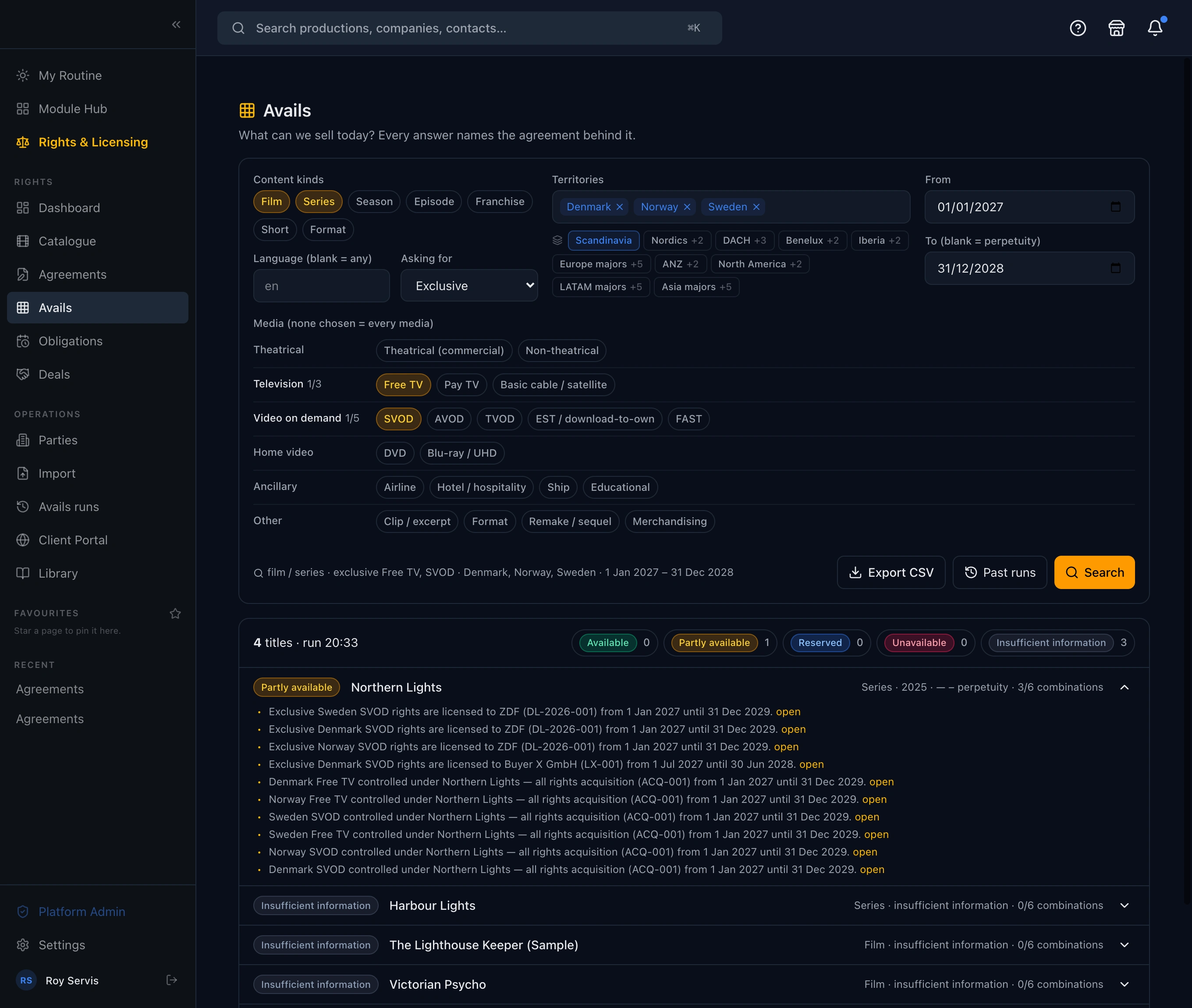
Enter a bundle — "all television, Scandinavia, 2027 to 2029, exclusive" — and Routine breaks it into one row per medium, territory and language. Blocs expand through your own territory groups or are refused by name, never guessed.
Ask what you can sell: green, amber, red, blue or grey per title, with the windows actually free and the clause behind every colour. The answer is computed in the database, once, and the app never recomputes it.
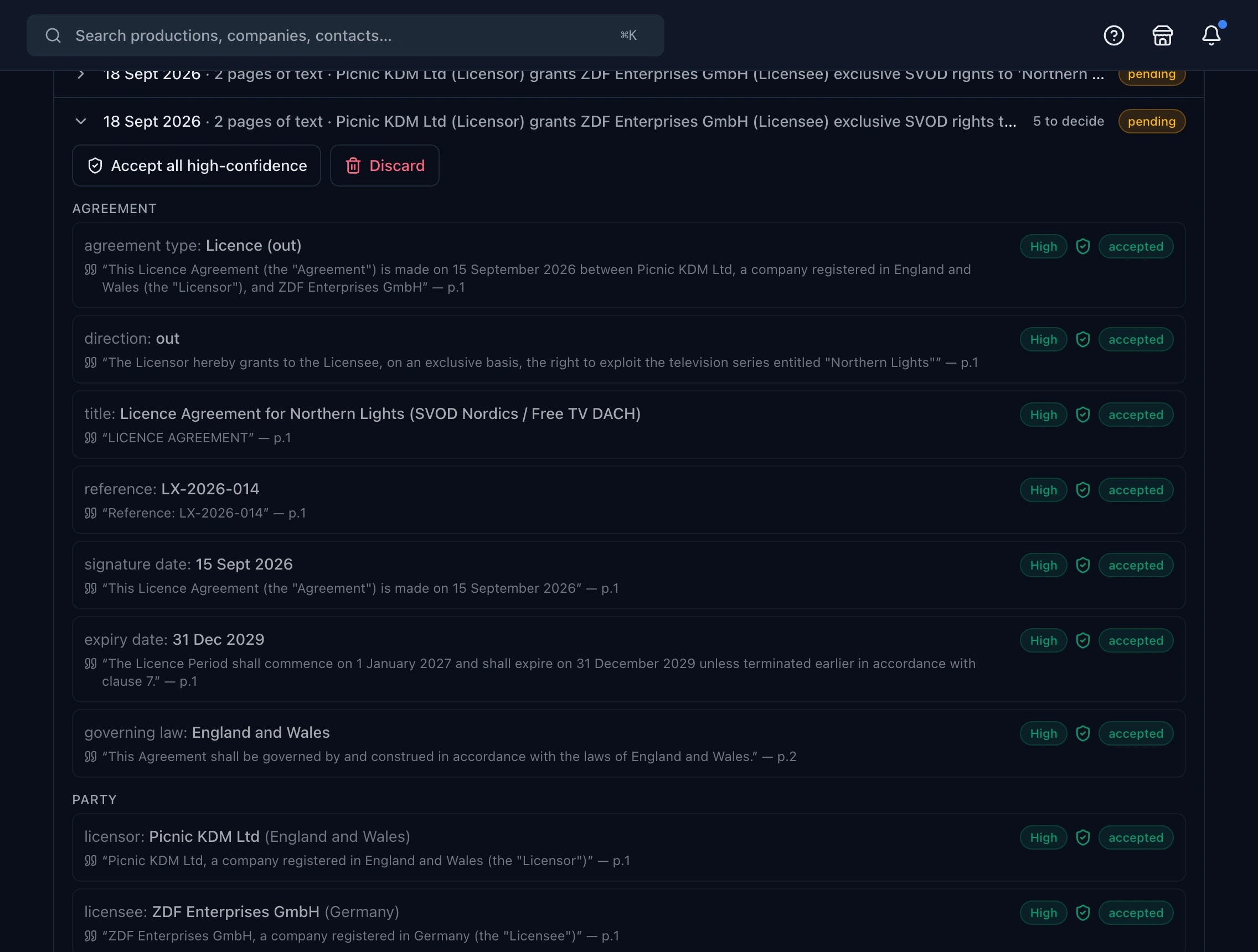
Attach the executed contract and Routine reads it: parties, dates, rights lines, fees and instalments, each with the quoted clause and page. Every quote is checked against the document; anything the model cannot point at is rated low. A person accepts or rejects every proposal — nothing lands on its own.
A sales pipeline over the same engine: versioned offers and counters, holds that show blue to colleagues while you negotiate, and a one-click conversion into a licence that waits for an owner's approval. A deal memo PDF comes from the structured terms, never from a screenshot.
Pick the kinds of content, the territories, the media, the language and the window. Routine answers per title and lists every licence, holdback or missing acquisition that produced the colour — with a link to the agreement. Export the run as CSV; every export is kept so you can re-send it later.
You control it for the whole window and nothing in the way.
Some of the window, some languages or some territories — the free windows are listed.
A colleague is negotiating these rights; the hold expires on a date.
Licensed out, held back, or outside what you control.
No approved rights-in, or a title still marked incomplete. Grey never pretends to be green.
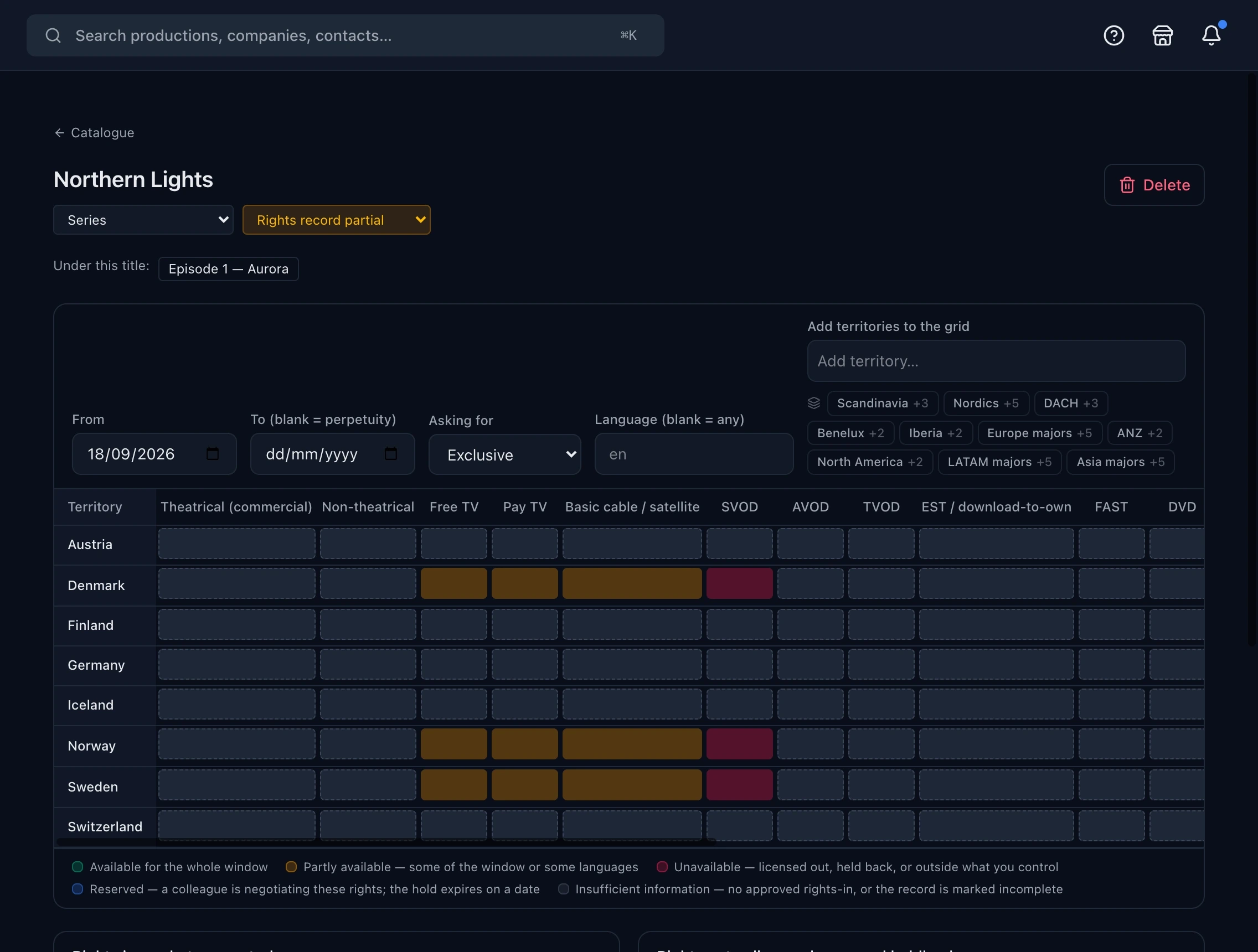
Every title page carries its own grid. Set the window, the exclusivity and the language and the cells colour themselves from the engine. Click a cell and Routine explains it — which acquisition brought the right in, which licence took it out, and when it comes back.
Add territories in blocs. Scandinavia, Nordics, DACH, Benelux, Iberia and the rest are one click; they expand through your own territory groups.
Leaf media only. "Television" is never a right on its own — the grid shows Free TV, Pay TV, basic cable and satellite separately, the way contracts do.
Rights record status. Mark a title complete, partial or unknown. Until a person confirms the record, its answers stay grey.
Attach the executed PDF and Routine reads it page by page. What comes back is a list of proposals — agreement fields, parties, rights lines, fees, instalments, obligations — each carrying the clause it was taken from and the page it sits on. The browser checks every quote against the document before you see it.
Verified quotes, or a low rating. A clause that isn't on the cited page is flagged and capped at low confidence. A scan with no text layer can't be checked, so nothing from it is rated above medium.
Rights lines go through the importer. The model's words — "all forms of television in the Nordic territories" — are resolved by the same rules as a pasted spreadsheet, and a bloc your organisation hasn't defined is refused by name.
A person decides every field. Accept, correct or reject; accept all high-confidence proposals at once. Proposals are never read by the avails engine and an approved agreement takes no extraction at all — amend it instead.
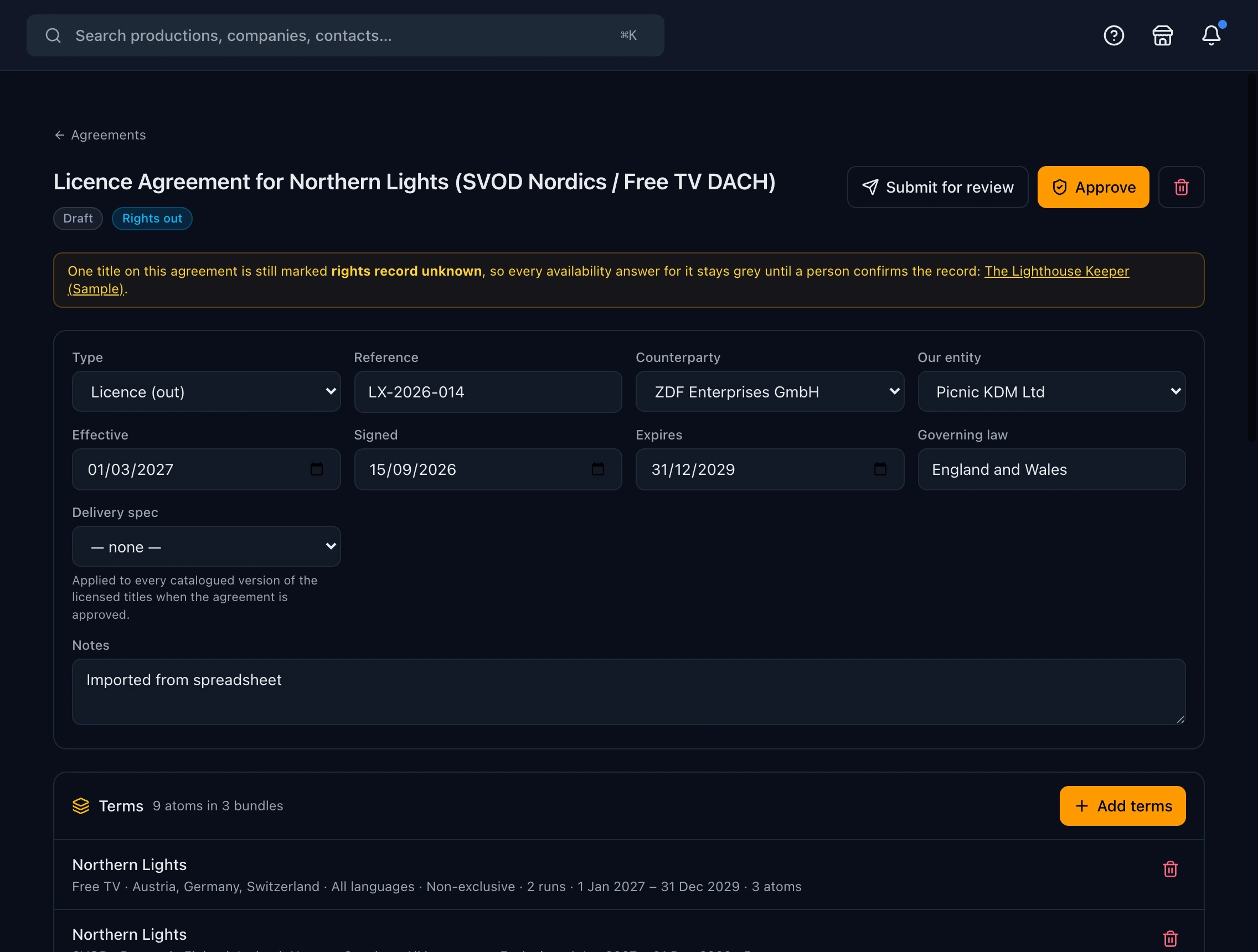
Type, direction, counterparty, your contracting entity, effective and signature dates, expiry, governing law, documents and notes — then the terms as bundles, exploded into atoms underneath. Submit for review; an owner or admin approves. From then on the terms are immutable and money is the only thing that stays editable.
Financial terms and a payment schedule. Licence fees, minimum guarantees and revenue shares per currency, instalments with due dates, invoiced and paid flags. Every instalment is an obligation; an overdue one surfaces in Finance.
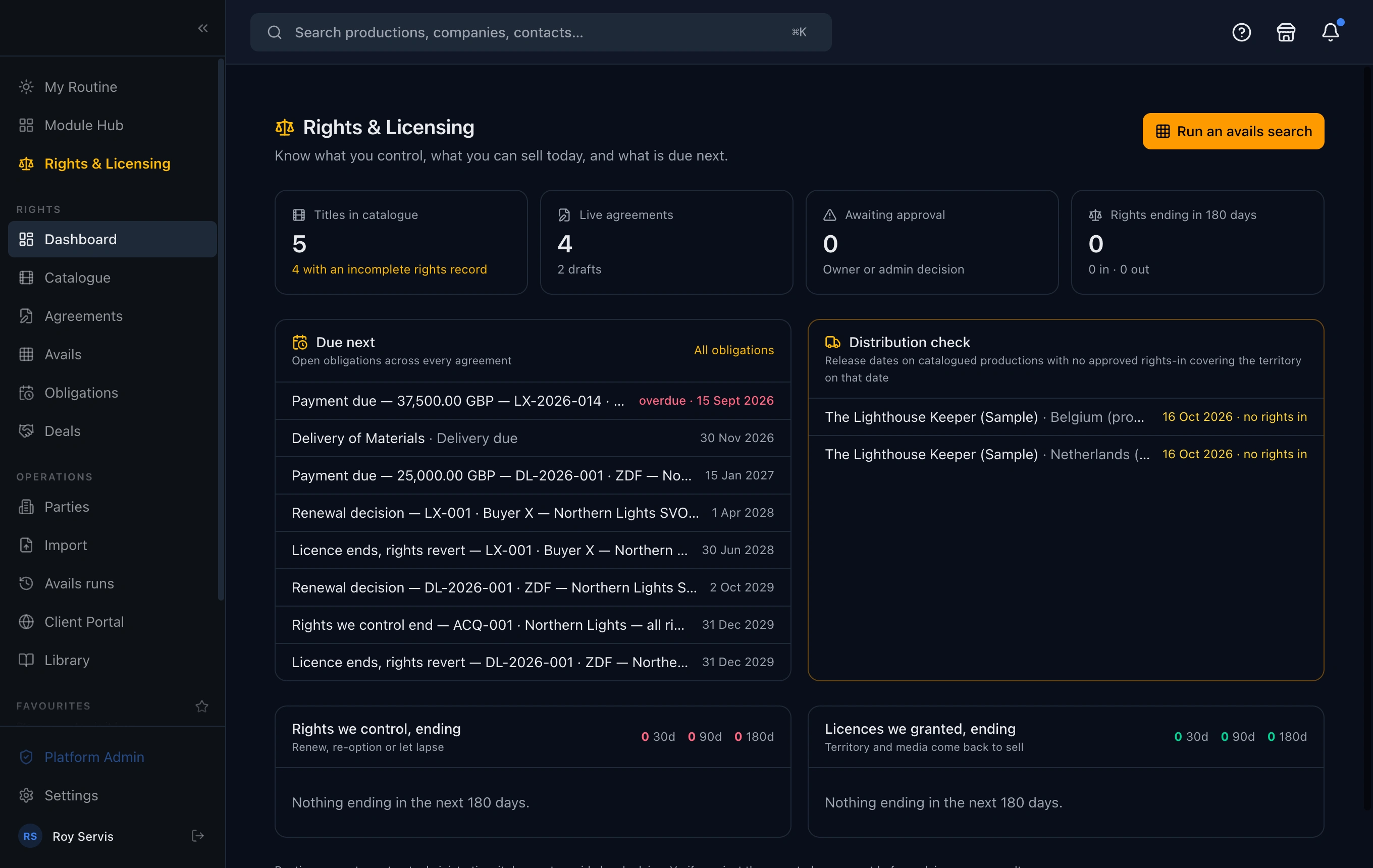
Obligations you can't forget. Renewal decisions and window ends are created for you on approval; deliveries, reports and approvals you add yourself. Due dates nudge the right people and turn into tasks.
Delivery spec on approval. On a licence out, name the delivery spec and Routine applies it to every catalogued version of the licensed titles the moment the agreement is approved — if you also run Distribution.
Rights you control that are ending and licences you granted that are ending are shown separately, because one is a loss and the other is stock coming back to sell. Open obligations, agreements waiting for a decision, titles with an incomplete record — and a check against Distribution for release dates with no rights behind them.
Most organisations need to know what they own long before they run a sales pipeline. Rights & Licensing is the record and the engine; Sales is the deals layer on top, priced as its own module and only available with the first.
Catalogue, parties, agreements, rights atoms, the avails engine and matrix, obligations, documents, contract extraction, spreadsheet import and recorded avails runs. Full seats only for anything that carries money.
The deals pipeline: enquiry to contracted, versioned offers and counters, holds that show blue across every avails answer, conversion into a licence-out agreement, and the deal memo PDF. Optionally linked to a CRM deal.
Routine supports contract administration; it does not provide legal advice. Verify against the executed agreement before relying on any result.
Try it free for 14 days — or tell us about your titles and your contracts and we'll walk you through it.
No card needed.